
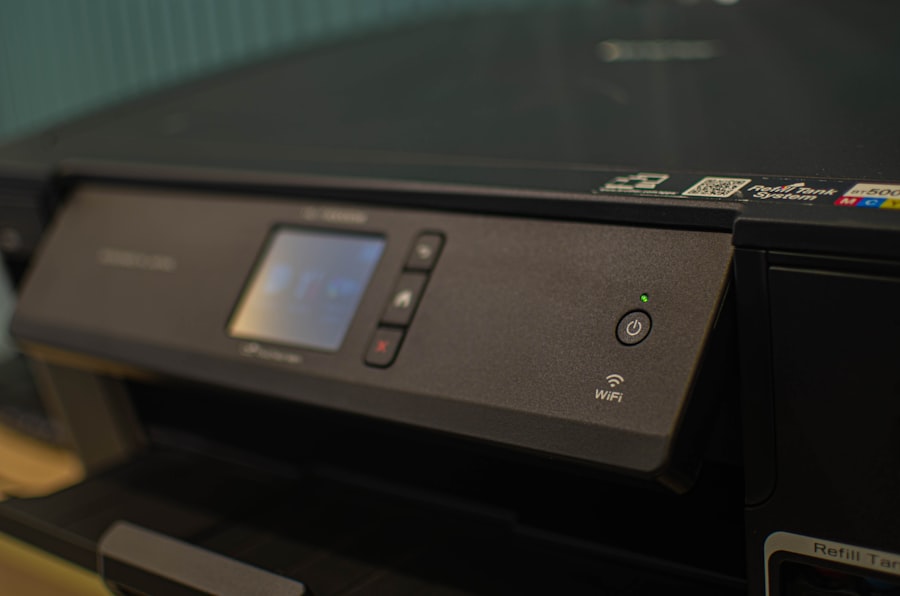
The term “printer” derives from the verb “to print,” which refers to the act of reproducing text or images onto a medium, primarily paper. This technology has fundamentally transformed the dissemination and sharing of information. The printer has become an essential piece of equipment in professional, educational, and home environments, enabling the production of a wide range of documents, from simple sheets to multicolor printouts.
The etymology of the word “printer” is linked to the emergence of printing in Europe in the 15th century. Following Johannes Gutenberg’s invention of the printing press, the demand for devices capable of large-scale text reproduction grew. The term “printer” then became established to designate these devices dedicated to this reproduction function.
- Summary: The word “printer” derives from the verb “to print,” related to the reproduction of text.
- “Photocopier” comes from the combination of the words “photo” (light) and “copier” (that which copies).
- The printer has a rich history, beginning with traditional printing presses. The photocopier revolutionized document duplication thanks to electrophotographic technology.
The evolution of printers and photocopiers has profoundly transformed communication and work in society.
Etymology of “printer”
The etymology of the word “printer” is directly linked to the Latin root “imprimere,” which means “to press” or “to affix.” This Latin term is composed of the prefix “in-” and the verb “premere,” which means “to press.” This origin underscores the fundamental idea of printing: applying pressure to transfer ink onto a surface.
This linguistic construction accurately reflects the device’s primary function, while also incorporating a technical dimension that has developed with the advancement of printing technologies.
History of the Printer
The history of the printer is closely linked to that of printing itself. The invention of the printing press in the 15th century marked a decisive turning point in the dissemination of knowledge. Before this invention, books were copied by hand, a long and laborious process.
With Gutenberg’s press, it became possible to mass-produce books, thus making written material accessible to a greater number of people. Over the centuries, printers have evolved. In the 19th century, the advent of cylinder printers increased printing speed and quality.
| Later, in the 20th century, the invention of the electric printer and, more recently, inkjet and laser printers revolutionized the industry. These technological advances have not only improved print quality but also diversified the media and print formats available. | Origin of the word “photocopier” | The word “photocopier” is a relatively recent term that combines two elements: “photo” and “copier.” The prefix “photo” comes from the Greek “phōtos,” meaning light, while “copier” derives from the verb “to copy,” which means to reproduce something. Thus, a photocopier is a device that uses light to reproduce documents on paper. | The origin of the word also reflects the technology underlying the operation of photocopiers. These devices use a light-based process to capture an image of an original document and reproduce it on a new medium. This method has simplified and accelerated the document reproduction process, making the photocopier indispensable in modern offices. | |
|---|---|---|---|---|
| Etymology of “photocopier” | Word | Origin | Etymology | |
| Year of appearance | Main use | Printer | French | From the verb “imprimer” (Latin “imprimere”: to press, to mark) |
Late 19th century
Device that produces paper copies from a digital document
Photocopier
From “photo” (light) + “copier” (that copies)
Mid-20th century
Device that reproduces documents using a photographic process
The etymology of the word “photocopier” highlights the two essential components that compose it. The prefix “photo” refers to the use of light in the reproduction process, while the suffix “-copier” indicates the device’s primary function: copying. This combination underscores the importance of optical technology in the operation of photocopiers.
The term was popularized in the 1960s with the advent of the first modern photocopiers. Before this, document reproduction was often carried out using less efficient methods, such as the mimeograph or duplicator. The emergence of the photocopier marked a significant advancement in document reproduction, making the process faster and more accessible.
History of the Photocopier
Leave a Reply